
Bless What Is Breaking
Songs for the wounded, the waiting, and the ones still praying

Most album reviews ask how the music sounds. This one begins with a different question: what kind of faith does this music make possible? When I heard that my friend Kate Williams was releasing Bless What Is Breaking, I wanted to listen, of course—but even more, I wanted to know what the songs were saying and what kind of congregational life they were trying to form. The music is beautiful. But the deeper achievement of this collection lies in its lyrics, its theology, and its refusal to hurry grief toward resolution. This is not simply an album to admire. It is an album to use: a resource for congregations learning how to sing sorrow, longing, protest, and hope together.
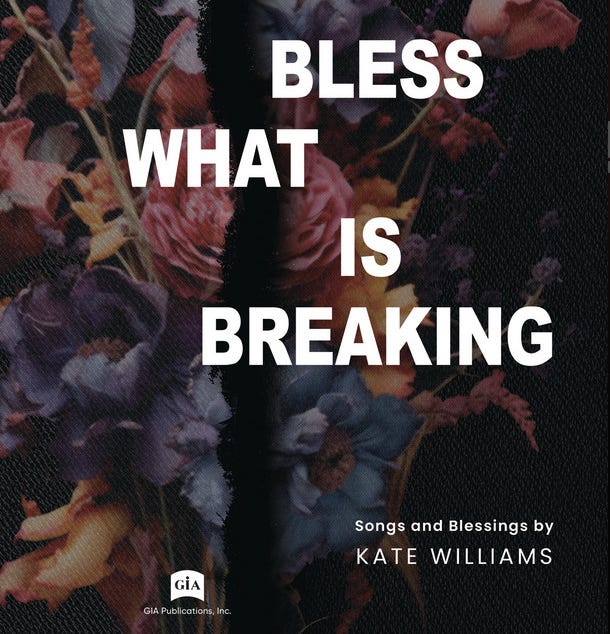
That is the frame for this review. I am reading Bless What Is Breaking primarily as a theological and liturgical text rather than simply as a musical performance, though it is a musically rich and singable collection. What matters most here is the kind of worship the album imagines: communal, contemplative, pastorally direct, and spacious enough to hold grief without denying beauty. You can listen to it here, but its deepest significance lies in how it equips the church to pray what many communities do not yet know how to say.
That need is urgent because there is a quiet crisis in much contemporary worship music: not a lack of beauty, but a lack of honesty. Too often, songs rush past grief, resolve sadness too quickly, or flatten the complexity of human experience into easy hope. Bless What Is Breaking refuses that habit. It insists that grief is not a detour in the life of faith but part of the road itself, and that songs worthy of the church must be spacious enough to hold sorrow without rushing it toward resolution. From its opening hymn onward, the album makes that argument with unusual clarity.
That posture is clear from the opening title hymn, “Bless What Is Breaking,” where the album announces its theological and emotional stance from the first lines:
“Bless all the grieving, the pain, and the cost. / Bless our refusal, confusion, and fear.”
This is not consolation that erases pain; it is blessing spoken directly into it. The song’s repeated invocation—bless what is breaking—names something rare in congregational music: the holiness of what does not resolve. Even the framing note makes explicit what many songs avoid: these texts emerge from “painful personal or collective change” and are meant for those seeking “honest and loving ways forward.”
From the opening song, the album signals that worship here will sound different: grief, pain, refusal, confusion, and fear are named directly—and blessed rather than corrected. People are recognized before they are instructed or comforted, and that recognition builds the trust on which spiritual care depends.
That same honesty deepens in “I Know God Holds You (My Love for You Goes On),” one of the album’s most devastating and necessary songs. Written out of experiences like miscarriage and ambiguous loss, the lyric refuses premature closure:
“Too soon I had to part from you, / too soon and you were gone; / I longed to love you long and true; / my love for you goes on.”
There is theology here—God holds, God remains—but it never eclipses the ache. The repeated line “my love for you goes on” holds together two truths the church often struggles to sing at once: love endures, and loss remains irreducible.
From there, the album widens its vision, extending grief beyond the personal into the communal and political. “No Room for Silence” refuses to let suffering remain hidden:
“No room for silence. / That time is past. / Voices are shouting—hear us at last.”
Here sorrow takes the form of protest, insisting that lament is not passive but active, not resignation but resistance. Similarly, “God Bless Our ‘No’” frames anger and boundary-setting as spiritually necessary:
“God bless our anger and our fear. / No one should be erased.”
These songs expand the emotional vocabulary of worship beyond private sadness into shared grief shaped by injustice, trauma, and collective wounds.
The album’s power lies not only in naming pain but in refusing to sever lament from hope. As the foreword suggests, lament is possible because we sense “something better is possible and promised.” That promise appears in songs like “Light Is Kindled in the Darkness,” where hope does not erase grief but rises beside it:
“Though the wrong appears victorious… / hope still rises from the wreckage; / joy and grief stand side by side.”
That last line may be the album’s thesis. Not joy after grief—but joy with grief. Not triumph, but coexistence.
Even the more explicitly hopeful pieces resist sentimentality. “For You, My God, I Wait” describes depression not as a problem to solve but as a condition to endure:
“Like sleepless ones who long to dream / I wait and call my Lord.”
Waiting here is not a spiritual failure; it is faithful persistence. Similarly, “In the Rising and the Setting Sun” offers remembrance that is tender but unsimplified:
“In the empty ache of grieving… they remain with us in God.”
The ache remains. So does the connection. Both are true.
Many worship songs prescribe emotional states such as rejoice, trust, and celebrate, but this collection offers something gentler: permission to grieve without resolution, to feel anger, and to wait without clarity. Even the title, Bless What Is Breaking, does not try to solve what is wounded; it sanctifies what already is. The pastoral effect is significant: people are allowed to remain where they are and still know they belong.
What makes Bless What Is Breaking especially important is its timing. In an era marked by pandemic aftermath, political trauma, and personal fragmentation, the church does not need more songs that rush to resolution. It needs songs that can remain truthful within the unresolved, and this collection answers that need with unusual clarity and courage.
The preface names it plainly:
“Maybe you feel broken. Me too… Let us bless what is breaking.”
That invitation—simple, direct, and unguarded—is the album’s deepest gift. It does not offer escape from sadness but company within it, reminding us that art truthful about grief is not optional but essential. Without it, worship becomes thinner than our lives; with it, it recovers something closer to honesty, and perhaps eventually, to healing.
A Necessary Counterpoint: When Honesty Risks Becoming Its Own Limitation
Still, precisely because the album is so emotionally and theologically disciplined, a counterargument deserves a hearing.
For all its emotional and theological depth, Bless What Is Breaking sometimes risks over-correcting. If much contemporary worship minimizes grief, this collection might be said to dwell within it so thoroughly that forward movement can feel muted. Where some traditions rush to resolution, this one hesitates to arrive at it at all.
Take again “Bless What Is Breaking.” The repeated blessing of confusion, fear, and loss is pastorally powerful—but it offers little narrative arc beyond endurance. There is dignity in that restraint, but some listeners may find themselves asking: where does this grief go? What transforms it? The song resists answering.
Likewise, “I Know God Holds You” carefully holds together faith and loss, yet its emotional center remains in longing rather than reorientation. The line “my love for you goes on” is haunting precisely because it does not shift. It circles. For some, that circularity will feel true; for others, it may feel incomplete—an unresolved chord that never quite moves toward resolution.
Even the album’s hopeful songs operate within a restrained horizon. “Light Is Kindled in the Darkness” affirms that “joy and grief stand side by side”, but it stops short of imagining what reconciliation or restoration might look like beyond that coexistence. Hope remains present, but often as a quiet undercurrent rather than a driving force.
This raises a broader theological and artistic question:
Is it enough for worship music to tell the truth about grief, or must it also help re-frame it?
One could argue that without some sense of trajectory—however subtle—songs risk leaving communities in stasis. In liturgical terms, lament traditionally moves somewhere: toward trust, toward protest, toward hope, even if slowly. If everything remains in the register of naming and blessing pain, worship may risk becoming contemplative but not transformative.
Why That Tension Is the Album’s Real Achievement
And that, finally, is what makes Bless What Is Breaking so compelling.
The tension between these two impulses—the need for honest grief and the desire for movement beyond it—is not a flaw to be resolved but a truth to be held. The album does not solve that tension; it stages it. It gives us songs that refuse to lie about pain, even if that means withholding easy redemption.
In doing so, it exposes just how rare such honesty is. The question is not whether these songs go “far enough” toward hope, but whether most worship music has gone far enough toward truth.
If some listeners long for more resolution, that longing may itself be part of the album’s work. It creates space not only for grief but for the desire that grief be healed—a desire it deliberately refuses to satisfy too quickly.
That invitation is both the album’s strength and its risk. It offers accompaniment without closure, presence without final answers.
And in a cultural and ecclesial moment where so much suffering remains unresolved, that may be exactly the kind of music we need—even if it leaves us, at times, still waiting.
One of the collection’s strongest pastoral gifts is its movement from individual pain to communal speech. Even deeply specific griefs, such as miscarriage or unresolved loss, are written in language others can sing, so that private sorrow becomes shared prayer. That reduces isolation and allows the community to carry what individuals often cannot articulate alone.
Rather than explaining suffering, the album practices accompaniment. God is described less as solving than as holding, which aligns with one of the deepest instincts of pastoral care: presence matters more than explanation.
What makes this collection especially valuable is that it does not merely speak about grief; it gives congregations language to pray and sing together. These songs feel suited not only to personal listening but to funerals, services of lament, healing liturgies, ordinary Sundays marked by local sorrow, and seasons when a congregation has suffered loss or fracture. In that sense, Bless What Is Breaking is not simply music for grieving individuals but a liturgical resource for communities learning how to tell the truth before God.
Theologically, the collection’s distinctiveness lies in the kind of church and human person it imagines. These songs assume worshipers arrive not as triumphant selves but as wounded, waiting, and unresolved people whose sorrow is not a distraction from faith but one of its conditions. They imagine the church, in turn, as a community spacious enough to bless what has not yet healed.
For that reason, pastors, worship leaders, liturgical planners, and grieving communities should take this collection seriously. Some congregations may want a stronger arc toward resolution, and that remains a fair question. Even so, that hesitation clarifies the gift this music offers: not denial or therapeutic uplift, but songs sturdy enough to hold sorrow in the presence of God.
Most grief albums are meant to be listened to.
This one is meant to be used.
And that changes everything.
Or, to use its own language: it does not try to fix what is breaking.
It teaches us how to bless it instead.
Hey, Daniel! What a profound review. I can’t wait to sit with this recording and live in it for a while after reading your thoughts. You are such a deep thinker and such a great writer. You always take me to places I would not have arrived at myself. Thank you. Out of paragraphs of thoughts that moved me, the line I really loved was “What kind of faith does this music make possible?,” followed by “What kind of congregational life is it trying to form?” I’ve spent decades teaching worship leaders how to build the right repertoire of songs for their congregations and have never thought of it in the terms you’ve expressed here. Wow. That is so, so good. I’ll credit you, but those thoughts will certainly become a major part of my teaching on this in the future! Again, I was touched, challenged and moved by your thoughts this morning. It was a great way to start my day. Now to go listen to the album!