
Blessed, Stressed, and (Joyfully) Relieved
Worship Leaders vs Congregational Feeling

The Joy of the Lord and Congregation
I asked the worship leaders some questions regarding their feelings post-worship services. My aim was to comprehend the level of effort required to organize and lead a worship service. The responses received were consistent and aligned with expectations. One of the Reformed worship leaders wrote that they were “more focused on what goes on off the stage in congregational life than what happens onstage” which is echoed throughout the survey, showing that the worship leaders care deeply about their congregations. The responses indicated that worship leaders are deeply attuned to the congregation's atmosphere and often internalize these sentiments.
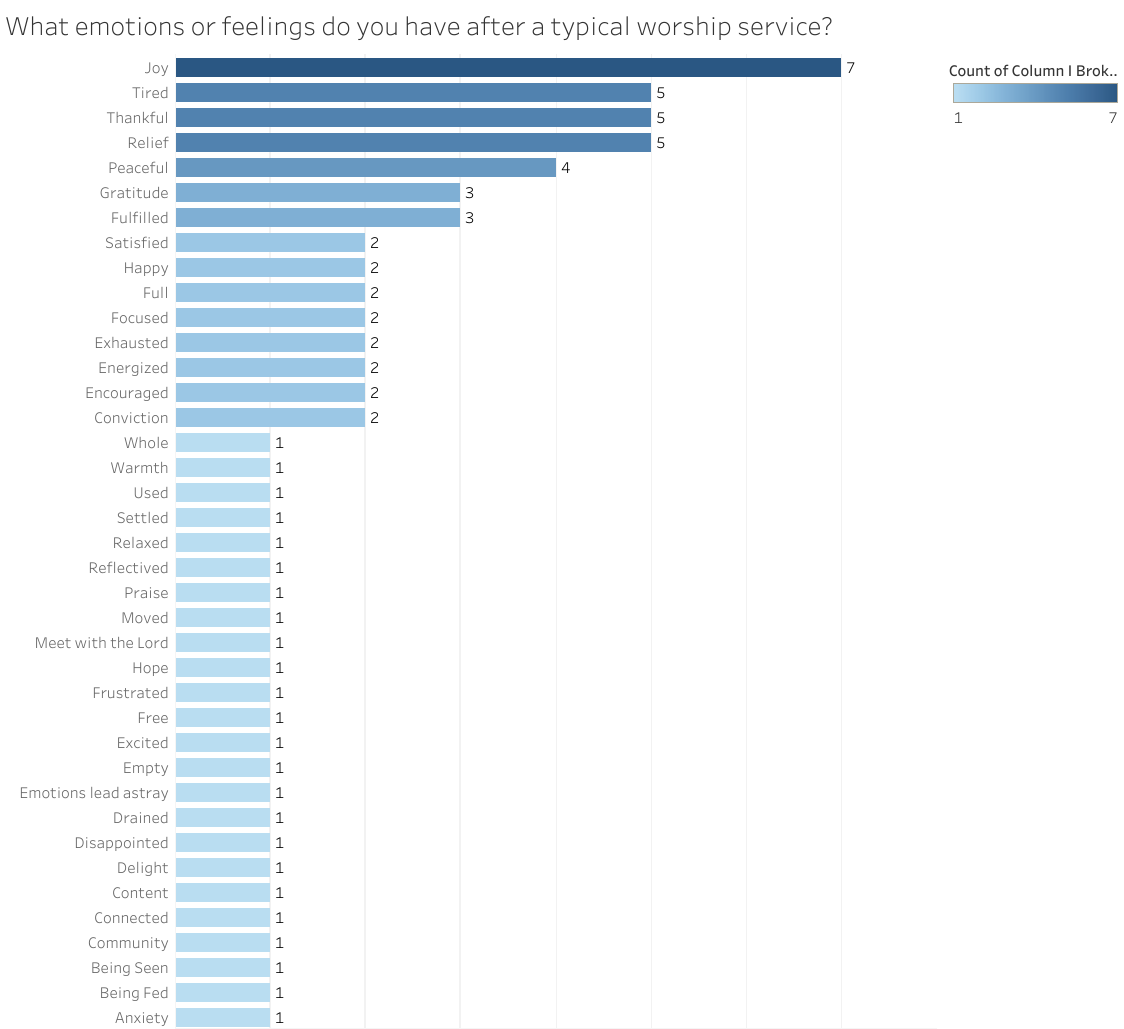
Worship leaders predominantly reported experiencing a profound sense of joy following their service. This joy can be categorized into two types: the joy stemming from witnessing congregants' spiritual encounters and the joy derived from observing interpersonal connections among attendees. For example, an experienced Presbyterian worship leader expressed feeling "joy in the knowledge that I've helped people to connect with God" after leading worship, a sentiment commonly echoed throughout the responses. It is evident that worship leaders derive a reflective joy from the congregation's spiritual experiences, significantly influencing their emotional state post-service. An Episcopal leader noted feeling “seen by God and having God see me. Being part of Christ's Body. Having been fed by the Eucharist. Delight in my relationship with God and with one another.” Similarly, a Reformed worship leader described joy and encouragement from being “with my brothers and sisters in Christ singing songs and fellowshipping, and then convicted to apply and follow what the Holy Spirit revealed through the preaching of God's Word.” The communal aspects of worship drives joy which then brings feelings of peace, gratitude, thankfulness and energy.
Exhaustion, Stress, and Relief
One of the Reformed worship leaders’ cuts to the quick and wrote, “Let’s be real it can be stressful to be a worship leader, it's a lot of work. So, when the service is done, I am normally tired and ready to go home. I put a lot into worshiping and making sure the service is good, and I have a lot of expectations for myself and for how it’s going to go. But God always meets me where I am reminding me of who he is and the reason why I am a worship leader. So, I feel a fullness and completeness as I leave as well.” Leading worship is an enriching experience that provides a unique opportunity to foster a connection with God. Nonetheless, it encompasses several practical responsibilities. A worship leader must organize 4-6 songs, coordinate multiple musicians and instrumentalists, meet the pastor’s expectations, and address the congregation's preferences. Additionally, they may need to maintain records of the repertoire, including the dates and frequencies of the songs performed. This role requires significant responsibility and effort. That effort leads to exhaustion and stress.
Part of the stress mentioned by a worship leader is making sure that tech glitches or programming issues do not interfere with the service. The leaders also discuss watching the congregation, trying to gauge the engagement, and being stressed that the team is failing to lead the congregation into worship. At least one worship leader reported that the expectations and obligations placed upon them makes them anxious, along with them having a touch of stage fright or imposter syndrome.
Often, worship leaders juggle these duties alongside other occupations and receive compensation for only a few hours per week; some even serve as unpaid volunteers. Furthermore, the commitment can impact personal time, as exemplified by a leader who must conduct three masses on Sundays, resulting in substantial time away from family. Or as another leader reports, they are splitting their time between leading the congregation in worship and make sure that their kids are behaving in the pews. The distractions surrounding life do not disappear in worship and are felt by the leaders.
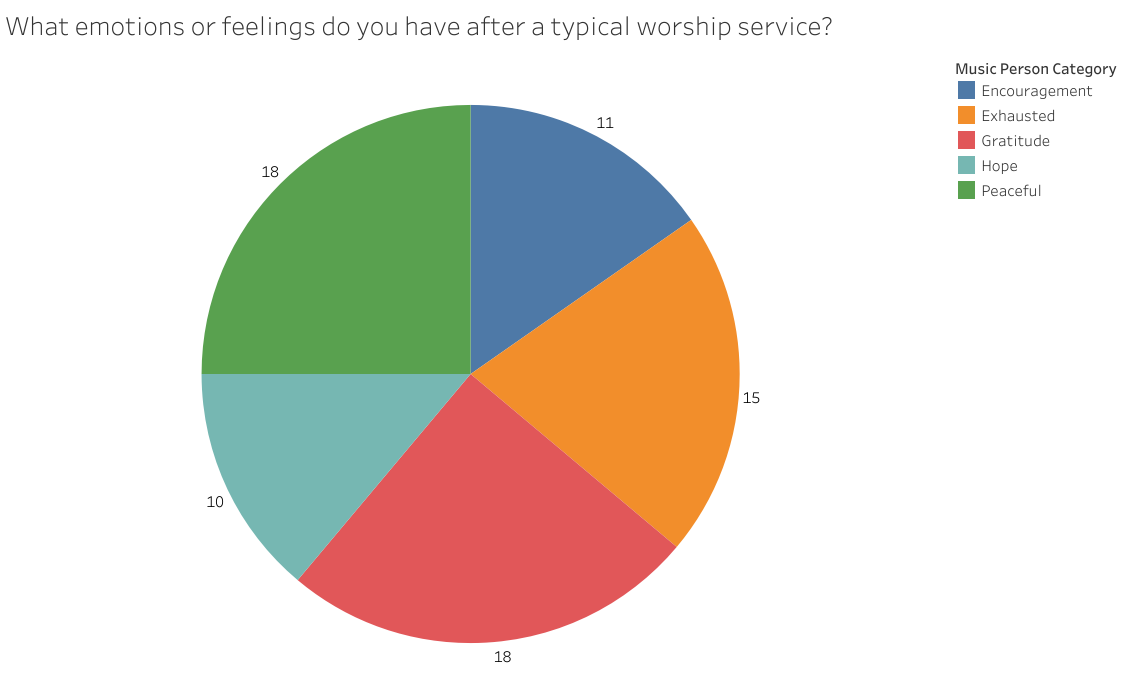
Two of the worship leaders who report feeling fatigue or exhaustion at the conclusion of a worship service perceive these feelings positively. One leader describes the experience as feeling “Used, Empty, Grateful, Whole," indicating they have given their full effort while also feeling spiritually enriched and thankful for the time spent in worship. Another leader reports feeling “Encouraged, and exhausted,” while a third leader notes, “I feel tired after exerting the emotional energy of leading,” comparing it to the feeling one might have after an enriching, long, deep conversation with a friend. These perspectives on tiredness provide an alternative view to the joy previously mentioned. Although the feeling is described differently, instead of being energizing, it is draining in a fulfilling way.
Five leaders reported that the feel relief after worship services or mass has ending. 4 of those speak of relief as being glad that the service is done, the worship experience went well, and hat they can go home and rest. The fifth leader puts a theological spin on the concept, saying that they feel relief that “Christ has paid the full weight of my sins.” The leaders’ sentiments all revolve around feeling like worship has happened, even if they were stressed about the process or relieved that worship has occurred.
Hopeful, Encouraged, and Thankful (that it’s over)
As a follow-up question, I asked the leaders how they thought their congregations felt after worship. Almost half of the respondents answered that their congregations felt Hopeful, thankful, or encouraged after the service. When you add an interpretive lens to better categorize the responses together, 9 say peaceful, 11 leaders say that their congregations feel encouraged, and 15 say hopeful.
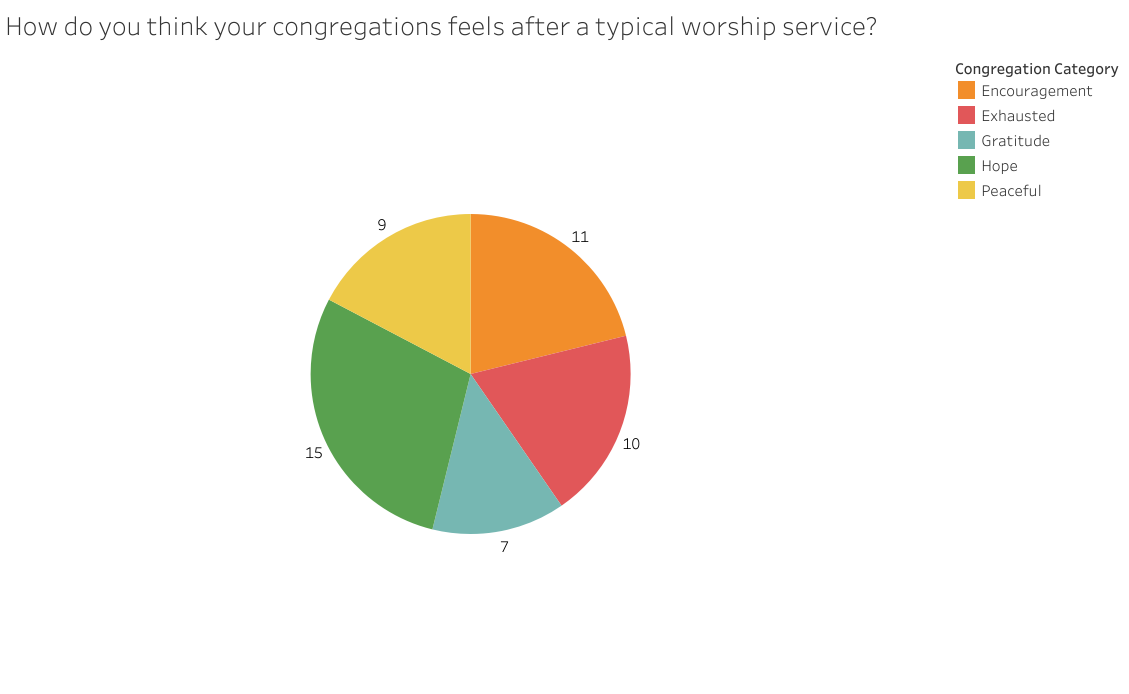
Conversely, ten respondents indicated that they believe their congregations feel tired after the services. One of my favorite remarks from the study describes the congregation as feeling "like a good meal and a cat nap" post-service. This sentiment likely reflects a cultural practice where individuals return home to enjoy a substantial family meal followed by an afternoon rest after church. Another significant comment is that some members express feeling “glad the obligation is fulfilled,” or, in the case of extended services, they are relieved when it concludes. Some people see church as something that they have to do or are supposed to do, and there is nothing that worship services can do to change their mood. There are also times when people are just tired from a long week and need a rest that they do not get at church.
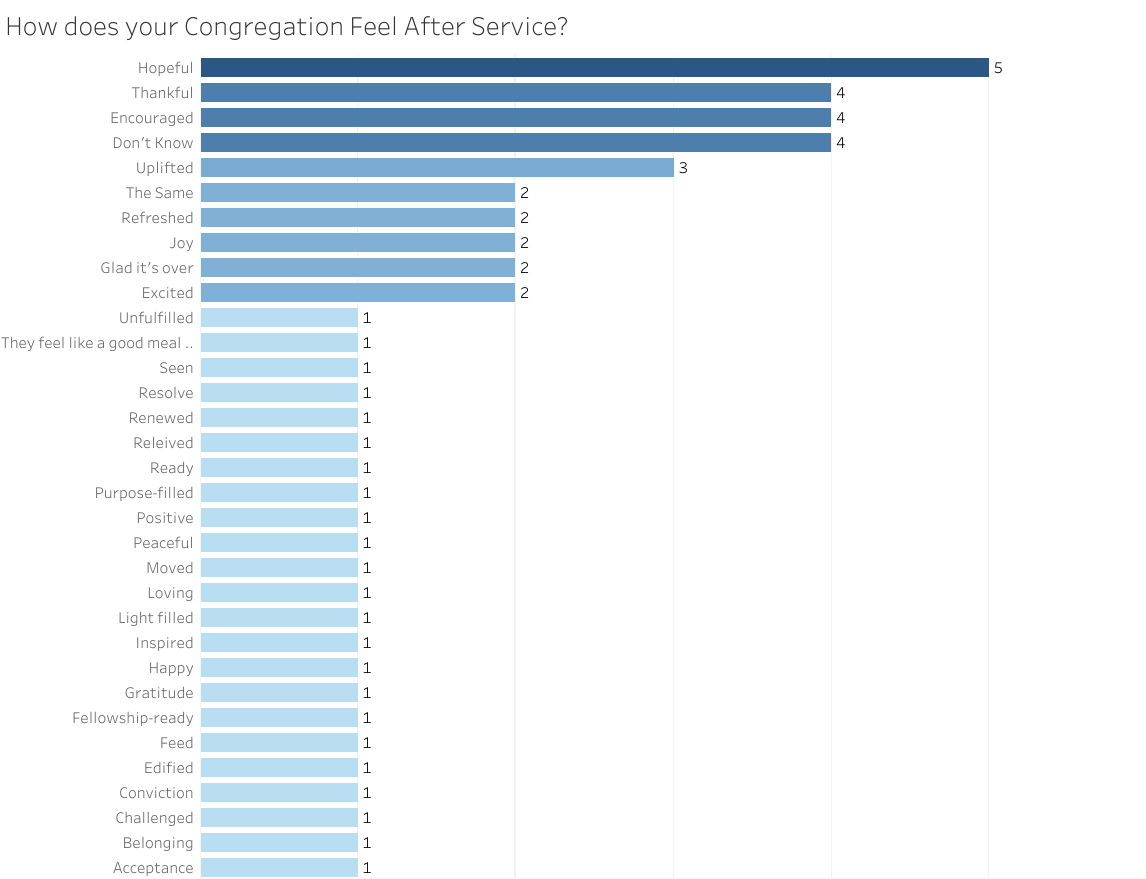
The comments typically include statements such as "I would hope they would feel," "I think they feel," or "I have the impression that the congregation feels a certain way after the service." Some worship leaders have mentioned that they do not know or are uncertain how to answer this question. From reading the comments and listening to the worship leaders I have interviewed, it seems there is not always an effective system for leaders to obtain feedback about the service unless it involves complaints about singing too many hymns or praise and worship songs, or not singing the song that attendees preferred on that day. One leader mentioned that the “Main feedback is usually personal preference stuff (which they usually realize is them) or technical stuff that needs taking care of” and the rest of the leaders who spoke about congregational feedback echoed that sentiment. The other repeated feedback is a vague thanks or good job, but it is rare to hear detailed and in-depth comments.
Conclusion
Congregations seek to worship in a way that resonates with them, often choosing a church whose style of worship aligns with their theological and stylistic preferences, despite occasional differences. The leaders aim for their congregation to leave the service feeling fulfilled, grateful, and as though a sense of community with God and others has been fostered. The leaders indicate, for the most part, that they want to leave the service feeling the same way.
We must remember though, being a worship leader is a lot of work. We can easily think that they just show up, sing a few songs, pray a couple of prayers, and engage in worship the way we do as a congregation. Talking to worship leaders, leading worship is more than a job but at times it feels like how any other job feels. I do not want to harp on the worship leaders who feel stressed or exhausted by leading worship because people put large obligations on them. Often, if the congregant feels like they did not worship that day, they blame the leader. We, as congregants, need to give worship leaders grace as they try to shepherd their flocks and form them emotionally and spiritually.
In order for emotional formation to occur in the church, and people to start feeling deeply and fully, more connection needs to be made between the worship leaders and the congregation. The majority of the churches which I survey do not have any official means of feedback. There needs to be more than a form, because usually only negative or unhelpful comments are made with those. The laity needs to partner more with the leaders while the leaders need to be more seeking of comments. Further, there needs to be more emotional variety occurring in the services. I feel like that is a given conclusion in my posts, but the data keeps backing up the conclusion. People feel joy and edification during worship services, and walk away with that feeling. Worship leaders feel blessed and grateful when worshipping and leaving worship. Again, those are good things to feel but should not be the only things that are felt.
One comment did say that the only real feedback they get is that Advent and Lent are too sad. Instead of responding to a comment like that by removing the sadness from those seasons, the church should take the opportunity to teach the congregation about sadness and use such a comment as an impetus to integrate feelings other than joy into their services. It is a difficult ask, but with the leadership and the congregation being willing to grow and learn from each other it is implementable.
I vote for making Advent and Lent more sad.
Okay this is so fascinating and I especially like your points about the necessity of feedback. I’m still trying to wrap my brain around a system for feedback that isn’t a form and is instead, perhaps, an ongoing conversation of some sort.