
One Worshiper as Another
Sympathetic Imagination, Re-Interpretation, and Worship

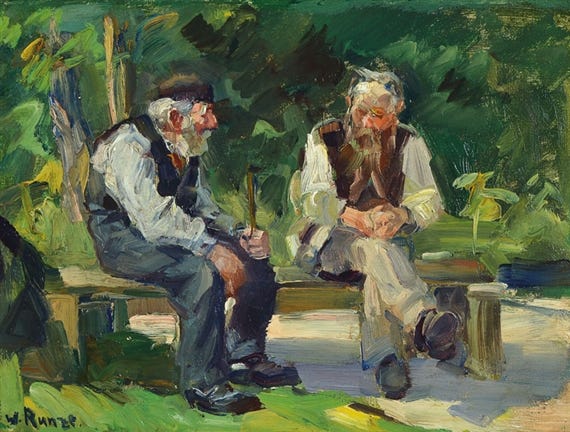
I recently finished Paul Ricœur’s Oneself as Another, and while it is a dense book that does not clearly address emotional formation or music, I found some interesting connections between his work on narrative identity and emotional formation that I wanted to share here. As a supplement, I have been reading Christina Gschwandtner’s Reading Religious Ritual with Ricœur, and she dives into the connections between liturgy, formation, and narrative identity.
The gist is that we are not ourselves and need other people. That summary works for Ricœur’s book, this post, and worship in general.
Oneself as Another
Ricœur’s work in Oneself as Another is arguing that identity, who you are, is not as straightforward as we often think it is. The question of identity is one of those questions that you think you know the answer to but cannot easily define it. The question, “who are you?” is one of my least favorite questions to try to answer. Am I defined by career, hobbies, familial connections, a combination of those, or something more? Or are they asking a deeper question, wondering how I would define myself?
A significant approach to defining the self in modern philosophy is attributed to Descartes. Descartes posits that the essence of personal identity lies in the individual’s capacity for rational thought. Now, we know from the series of posts on Disability Theology from the last month that saying a person is only a person if they are rational. We also know that defining a person by their ability to be an isolated, autonomous self is problematic.
Ricœur’s definition of a person challenges both offerings from Descartes. Ricœur argues that the self is relational and dialogical. The argument gets technical and we’re not hear to get bogged down in the nuances so I’m going to offer a reductionistic but faithful breakdown of what Ricœur means.
Ricœur wants to understand that a person knows who they are through interpretation. That means we know who we are through reflection and trying to understand how our lives have meaning. In that process, we view ourselves as a narrative, a story that we can read and re-read and assign meaning to events while also seeing parts of our lives being important depending on when we “read” our life. It’s like reading a book and finding one thread as what stands out to you and then re-reading it in a different stage of life and finding that the previous thread we thought was important has faded and another part of the story jumps out to us as the most important way to understand the story.
We do not engage in that interpretation alone. We can only understand our lives through talking through our stories with others. We cannot understand ourselves, our story, without having conversations about ourselves with others. The other people who are reading the story of our live with us will point out passages that we glossed over, ask probing questions that we avoid asking ourselves, and help us work through how everything goes together.
Inside of our narrative, we find that there is Sameness along with Selfhood. Sameness stands for the traits that are stable and have continuity. Selfhood is more dynamic. The traits that Ricœur would place under Sameness would start with name and legal identity. He gives the example of having the name Paul Ricœur registered with the government on multiple occasions and documents, showing that we treat a person as the same person throughout their life. There are also some social and physical moments of continuity. He uses the examples of being a parent, citizen, or professional as the social roles that usually stick. We also say that my physical body, even though it changes, has continuity through the changes even if that is difficult to nail down. Sameness says, “I am the same person because I have the same name and traits.” For Ricœur, these traits are less important and interesting.
What makes “me” me is my capacity to be responsible and promise. What holds together my identity is the story of my life, where it shows that throughout the changes, I have been able to remain the person that keeps fidelity and promises. Selfhood is much less concrete and harder to point at marker of who we are sometimes, but that is because to tell someone who we are, we must engage in narrative. Ricœur would answer the question, how do I stay the person I am, with “I remain myself because I keep my promises, even as circumstances change.”
Ricœur rejects the notion of the self as self-contained, proposing instead a hermeneutics of the self like interpreting a text. Selfhood is never solitary; it requires mediation through language, symbols, and encounters with others. I can only know myself through others. Since I can only know myself through others, my self appears as another to me, because it is not immediately accessible to myself.
Reading and Performing Music
So, what does this have to do with music and emotional formation?
Paul Ricœur explores the connection between reading and performing music, providing insights into how emotions are shaped, especially within Christian worship music and liturgy. He likens reading to playing a musical piece, where both involve interpretation, active participation, and immersion in the world conveyed by written words or musical notes. When we look at notes on a page, like on a musical score, we tend to think that it tells us exactly how to play the song as the author intended and we just need to faithfully follow the score and reproduce the music, and it will be exactly what is always performed. But we know that some people rush or drag the tempo, hold notes a little longer or shorter, play quieter or louder, all these variations change how we experience the song. The same is true for reading a text. We insert breathes, pauses, and regional or cultural pronunciations. We bring the books we’ve previously read by the author or in the genre with us and bring those into the reading.
We bring our stories and the stories we have been told into the music.
For Ricœur, “Reading resembles instead the performance of a musical piece regulated by the written notations of the score” (HHS, 174). Through this analogy, Ricœur emphasizes how these acts require both engagement and creative interpretation. He also points out that music has a distinctive power to generate unique feelings and extend emotional experiences beyond what language can express, favoring music that stands apart from external intentions rather than sacred music rooted in texts. The listening to or playing of the text (musical score) transforms the way that we interpret and interact with it. In much the same way, elaborate liturgical practices deepen personal emotions and thoughts, encouraging participants to imaginatively connect with the experiences of others through “sympathetic imagination.” It’s not just our individual feelings that matter; it is how the music invites us in together and how we interact with the music together that matters.
Building on Ricœur’s analogy, we see that the act of engaging with music or liturgy is not merely mechanical but involves an ongoing negotiation between fidelity to the original and the creative possibilities each participant brings. This process underscores the transformative capacity of both music and worship: as individuals immerse themselves in the performance or ritual, their emotional landscape is reshaped, and new regions of feeling become accessible. In this way, Ricœur’s insights highlight how active participation, whether in music or liturgical action, opens opportunities for personal renewal and deeper communal bonds, inviting each person to recompose their narrative and experience the world in fresh, meaningful ways.
Ricœur’s aesthetic theory further underscores music’s singular capacity to generate unique feelings—emotions that exist only within the confines of a particular musical work. He writes, “each piece of music gives rise to a feeling that exists nowhere else except in that particular work,” and posits that music “constructs a world of singular essences in the realm of feeling.” In this sense, music’s emotional reach transcends the limits of language; it opens new regions of experience, creating feelings that have no precise name, and extending our emotional landscape. Ricœur is saying that songs blend and elicit emotions in a way that they are not purely “joyous,” “sad,” or “angry.” They are somewhere in those categories, but the categories we usually think of fall short of offering a true definition of what we are feeling while listening.
Ricœur is notably critical of sacred music that serves a textual purpose, likening it to figurative painting “in service of a text.” Ricœur is against trying to hard to make a song elicit an emotion as it then no longer can be interpreted imaginatively, as it almost has a fixed meaning. Think of the sappiest, most sentimental, tug at your heart strings, song you can. It feels manufactured and manipulative to the point that it is cloying, and you cannot fully engage with it.
He champions music that is free from external intentionality, arguing that only in such moments does music possess its fullest power to regenerate and recompose our personal experience. Listening to a specific piece of music, he contends, grants access to a unique region of soul, a territory that can only be explored through the act of listening itself. It’s the difference between writing a song that lets people enter worship and a song that tries to shove people into worship or have a feeling.
Sympathetic Imagination
When considering Christian worship music within liturgical settings, Ricœur’s ideas help us understand how elaborate liturgy intensifies and amplifies the emotions, thoughts, and experiences that participants bring to worship. The liturgical drama does not merely heighten personal affect; it also presents models and exhortations that invite worshipers to imaginatively identify with the experiences and emotions of others. This process, which Ricœur refers to as “sympathetic imagination,” allows individuals to enter the lives and dispositions of others, taking up those emotions as their own.
Imagination plays a dual role in this process. On one hand, it fosters repetition and familiarity, consolidating emotional experiences through imaginative memory. On the other hand, imagination unsettles and innovates, enabling the creation of radically new possibilities and feelings. This dynamic is essential for the formation of narrative identity in worship: imagination must support the capacity for representation, allowing worshippers to enter and participate in the liturgical world. If the imaginative dimension becomes too detached—too utopian—sympathetic identification and meaningful participation become impossible. Conversely, if liturgy simply reinforces comfortable stereotypes and habitual patterns, losing its power to challenge and transform, it risks devolving into mere ideology.
This interplay between imaginative repetition and creative innovation means that worship and music become fertile ground for transformative experiences, rather than static rituals or predictable routines. By maintaining a delicate balance, encouraging both the comfort of shared memory and the challenge of encountering the unfamiliar, worship can continually renew and expand the emotional and narrative horizons of its participants. The liturgical space thus serves as a dynamic environment where individuals both reaffirm their identities and are invited into new emotional landscapes, making each act of worship a unique opportunity for growth, renewal, and deeper communal engagement.
For some, a prayer book might feel stale, but the additions of songs and texts that shift inside of the static prayers allow for the service to keep the Sameness will having the Selfhood that I discussed at the beginning. The order of the service stays the same, the people leading (at least the titles) stay the same, the name of the congregation does not shift week from week, while the people’s stories and the narrative of the congregation continues to shift and grow and reinterpret, which leads to the service taking on new meanings.
Gschwendtner writes, “The dramatic configuration that occurs in elaborate liturgy, then, takes the emotions, thoughts, and experiences we bring to liturgy and heightens, deepens, and amplifies them. At the same time, it challenges us with other emotions and dispositions via the models or exhortations that liturgy presents before us or imposes on us. These configurations are also rooted in life, but in someone else’s life, with whom we can imaginatively identify.” When I sing with another person, I can share in their experiences and emotions. Even if I’m not feeling happy myself, joining in their joy allows me to experience happiness through them. This applies to other emotions as well; I can connect with feelings I’m not currently having by tuning into how those around me feel. Because these feelings are not mine, they are “imaginary,” but in the best way. They are feelings I am putting on so that I can be sympathetic to those around me, while allowing those feelings to help me re-interpret my feelings. It’s thinking that you are happy until you sit down to comfort someone and find that you are also in sorrow, because their story has intertwined with your story, which then changes the story and the way you read it.
Returning to Gschwendtner, “imagination must be able to function in terms of representation—its creative uses must undergird or support this capacity rather than overrule or even destroy it. If we can no longer imaginatively enter the world because it has become too radically different (too “utopic”), then imaginative “sympathy” (and hence participation) has become impossible.” If we use language in our liturgies and songs that are too idealistic or depressive, they will not seem real, and we cannot enter the world that they are creating. It’s like a movie that asks you to suspend too much of your disbelief or vision of what the world is like. It’s also like reading some of the fire and brimstone sermons of Jonathan Edwards or other preachers like him who speak in such a different tenor about who God is that we cannot get past the metaphors being used. “God is love and loves you” can be sickly sweet and a barrier to participation in the same way that “God is just and punishes you” can be too rough on our ears.
Gschwendtner brings it home by saying that “If the liturgical world has lost its capacity to challenge us, if it merely confirms our comfortable stereotypes and familiar habits, even when they are not conducive to holy living, then it has become mere ideology.”[1] If I only hear what I want to hear, how I want to hear it, and no longer have to engage in re-interpretation of the texts, myself, or the community, the liturgy has lost all meaning.
Therefore, the vitality of worship lies in its ability to continually provoke, unsettle, and draw the congregation beyond routine, inviting participants to reexamine their beliefs, emotions, and communal narratives in the light of something greater than themselves. Only when worship invites us into this ongoing process of reinterpretation and imaginative engagement does it remain a living, transformative force—one that cultivates not only a deeper sense of self but also a renewed openness to the stories and experiences of others. In this way, the liturgical space retains its dynamism, fostering the growth of both individuals and communities as they journey together through the ever-unfolding horizons of faith and feeling.
Imagination has two contrasting roles: it enables us to revisit and reinforce experiences within our memory, making them familiar and well-established; yet it also has the power to disrupt, inspire, and invent, envisioning possibilities—perhaps even impossibilities—that bring about change, optimism, and the promise of something entirely new. [2] If our worship loses these, it is no longer life giving.
Worshiping as Another
Ricœur’s philosophical framework illuminates how worship music and liturgical enactment serve as powerful mediums for emotional formation and narrative identity. Through active participation, imaginative identification, and the unique emotional resonance of music, Christian worship can open new regions of feeling and possibility, fostering both personal transformation and communal connection. Ricœur is saying that identity is not fixed; it is a task—a continuous interpretation of our lives through narrative, despite the fragility and unpredictability of existence.
The music we sing in church should help us interpret ourselves and our narratives while being aware of how our lives interpret the texts.
This reciprocal relationship between music and text enriches the worship experience, allowing congregants to not only engage with the liturgy on a personal level but also to participate in a shared process of reinterpretation and growth. As individuals sing and reflect, the boundaries between personal story and communal narrative blur, creating a dynamic space where faith is continually re-imagined and renewed. This ongoing dialogue between self, community, and text encourages participants to recognize how their own experiences shape, and are shaped by, the spiritual stories they encounter, fostering a vibrant and living worship that is responsive to both tradition and transformation.
[1] Gschwandtner. 152.
[2] Gschwandtner. 150-151.