
The Same Few Voices
Christian radio, artist concentration, and the narrowing of emotional formation

Christian radio does not simply accompany our commutes, errands, kitchens, and office afternoons. It trains us. Quietly, repeatedly, almost without our noticing, it teaches us what faith is supposed to sound like and, just as importantly, whose voices are allowed to carry that sound.
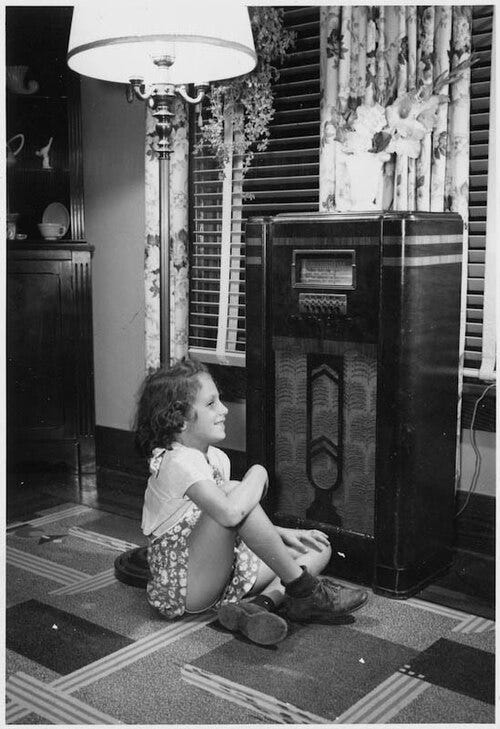
That is why the latest Pew Research Center data on religious radio matters. On paper, the landscape looks broad: nearly 14,000 artists appeared in a sample of more than 300,000 songs played on U.S. religious stations in July 2025. But abundance in a database is not the same as abundance in the ear. The deeper concern is what repeated exposure to a small circle of artists does to the emotional world of Christian listeners.
To see how that happens in practice, we can start smaller: with the public-facing playlist.
A Playlist as a Clue
The Spotify playlist is a useful starting point, though it needs a caveat. A public playlist is not broadcast airplay data; it cannot tell us what aired in a particular hour. But it can show the sound a major Christian radio brand wants listeners to associate with it. K-LOVE’s public-facing playlist includes 122 songs.
The concentration is already visible in the playlist’s most repeated artists:
Echo Worship — 12
Kevin Winebarger — 9
Anchor Worship — 8
The Worship Coalition — 7
Kai River — 7
Jonathan Jackson — 6
Lesley Jones — 5
Katie Braswell — 5
BLOOMHOUSE — 4
Pistol Creek Music — 4
1 King Worship — 4
Leah Paschall — 4
Brandon Sharp — 3
Presence Music — 3
Citizen Way — 3
Jake Fretz — 3
Hollie Schlueter — 3
Lauren Daigle — 3
Brady Steinour — 3
Hillsong UNITED — 2
The playlist does not simply mirror the familiar charts. It has an internal rhythm, as if it were meant to be heard as a sequence rather than sampled at random.
The Hidden Liturgy of a Worship Playlist
Most playlists are background: songs gathered around a mood, a commute, a workout, or a room that needs cleaning. This one does something more interesting. Whether intentionally or not, the K‑LOVE 2026 playlist has the shape of a theological movement: disorientation, assurance, surrender, praise, and finally a life sent outward.
What looks like a playlist starts to read like a map. What patterns would we notice if we listened for the story a playlist is telling rather than only the songs it contains?
It begins where many worship sets hesitate to linger: in disorientation, though only a certain kind.
Songs like “Rescue” (Lauren Daigle), “Just Be Held” (Casting Crowns), “Even in the Heartache” (Jonathan Jackson), and “Peace Be Still” (Hope Darst) seem to refuse to rush past pain. They name fear, exhaustion, and uncertainty. They sound less like proclamation and more like prayer. Worship begins, not with certainty, but with honesty. Still, that honesty has a boundary. These songs revolve around salvation and God’s sovereignty. The singer stands in weakness while God remains firmly in power.
At first glance, these songs sound like lament. They are cries to God. But they lack some of lament’s biblical sharpness. They ask for rescue more than they protest. They affirm God’s control more readily than they question God’s absence. The psalms of lament often speak with far less caution. They can accuse God of sleep or delay, as in Psalm 44:23–24 and Psalm 78:65. Psalm 78 even imagines God waking like a warrior from wine. That kind of candor is difficult to domesticate into a worship chorus, but Christian worship needs it.
These songs are honest, but within limits. They name pain and weakness without often naming frustration with God. Biblical lament presses further. It questions, protests, argues, and waits without easy resolution. The playlist gestures toward lament, then usually stops before lament becomes confrontation.
Where do the songs you return to make room for protest, and where do they move quickly past it?
Identity Re-Narrated
Songs like “You Say” (Lauren Daigle), “Tell Your Heart to Beat Again” (Danny Gokey), and “God Only Knows” (for KING & COUNTRY) begin to reinterpret the self in light of grace. The voice changes. It is no longer simply naming pain; it is reframing it. “I am held. I am known. I am not who I thought I was.”
After disorientation comes reframing. The playlist turns upward, moving from wounded identity into surrender.
Songs like “Holy Water” (We The Kingdom), “The Father’s House” (Cory Asbury), and “Turn It Around” (Kevin Winebarger) carry a different tone. They don’t just describe experience; they begin to yield it. This is the hinge moment where testimonials become worship.
The surrender, though, is often narrated as personal failure. These songs train the singer to inhabit the role of sinner in need of grace, which is true, but not the whole truth. The self becomes almost binary: sinner or saved. It is not even Luther’s simul iustus et peccator, simultaneously justified and sinful.
They also flatten emotional life. Sadness belongs to sin; comfort arrives with grace. But a person can be held by grace and still be sad. Not all sorrow comes from personal sin. Not all sorrow even comes from systemic sin. Sometimes sadness comes from being awake to our own humanity and to the humanity of others.
Full Voice: Adoration
Songs like “What An Awesome God” (Phil Wickham), “Goodness of God” (Bethel Music), “Holy Forever” (Katie Braswell), “You Are (Holy, Holy, Holy)” (Echo Worship), and “Psalm 147 (O What a Good Thing)” anchor this section. The language shifts from “I” to “You.” This is worship as direct address—shared, corporate, and God-centered.
But the movement does not stop at adoration.
Songs like “My Defender” (Tate Butts), “LIFT MY EYES” (Citizen Way), and “Peace Be Still” keep worship grounded in dependence. Even after praise, the prayer remains: we still need God. The problem is not praise, or confidence in God, or songs that trust divine rescue. The problem is how much of the ecosystem already lives there.
Even the songs that begin in disorientation often resolve into praise and adoration. They are songs of God’s loving kindness and saving action. Those are necessary songs. But they are not the only necessary songs. We also need music that gives fuller voice to frustration, pain, sorrow, protest, and waiting.
Praise Becomes Practice
Then, almost quietly, the playlist extends outward. Songs like “The Great Commission” and “God of the Nations” move beyond the interior life altogether. Worship becomes life. Praise becomes practice.
Taken as a whole, this playlist traces a path that looks remarkably like the historic logic of Christian liturgy: confession, assurance, surrender, praise, response, and sending. That arc gives the playlist more shape than ordinary background music.
The question is not whether that arc is meaningful. It is. The question is what gets lost when the arc resolves so predictably.
If this were the soundtrack of a congregation’s week, what feelings would it teach people to expect from God—and which ones would it leave unnamed?
On the Radio vs. Streaming
This is where the playlist opens onto the larger radio data. Streaming and radio are different systems, but both form us through repetition. A platform may hold thousands of artists in the background while the listener’s actual world remains much smaller. What shapes us is not the archive. It is what keeps returning through the speakers.
The Pew data lets us ask the same question at a larger scale. Religious radio looks broad at first: most of the songs are identifiable as Christian music, and the category includes contemporary Christian music, worship, gospel, country, rock, alternative, and more. The category may be wide; the repeated listening experience is much narrower.
The center of gravity is narrow. Contemporary Christian music and worship music dominate the soundscape, while the surrounding genres mostly orbit that center. There is variety, but it is fenced in—enough to make the landscape feel broad, not enough to alter the weather.
The numbers make that pattern visible:
Pop (42% of tracks are by artists tagged as pop)
Gospel (27%)
Country (21%)
Rock (19%)
Alternative (15%)
Regional differences complicate the picture without overturning it. Southern stations play more gospel and Christian country than stations elsewhere, but the national pattern still returns to the same center: contemporary Christian and worship music carried by a relatively small circle of repeat artists.
The emotional power of repetition
The genres matter, but the repeated artists matter more. Pew identified about 14,000 artists in the sample, but just 10 accounted for 16% of all songs played during the month studied.
These are the names many listeners already recognize: Phil Wickham, Matthew West, MercyMe, Chris Tomlin, Jeremy Camp, Zach Williams, Casting Crowns, Elevation Worship, TobyMac, and Brandon Lake. They are not just artists in rotation. For many evangelicals, they are part of the emotional vocabulary of faith itself.
Familiarity is not the enemy. Churches need durable songs. Listeners return to voices they trust. But durability can harden into dominance. When the same artists carry so much airtime, the concern shifts from musical quality to spiritual imagination: what kind of Christian life does this repetition train us to expect?
Who becomes spiritually familiar to us because they are repeated, and who remains unfamiliar because they are rarely heard?
The concentration becomes even harder to miss beyond the top 10:
The top 1% of artists by airtime accounted for 57% of song plays.
The top 10% of artists accounted for 87% of song plays.
Availability is not the same as repetition. Thousands of artists may exist somewhere in the data, but only a small fraction become part of what listeners carry in their bodies.
Why that matters for emotional formation
Music does not merely express emotion; it rehearses emotion. A song teaches the body how to move through fear, gratitude, grief, confidence, surrender, longing, and relief. Heard once, a song may encourage us. Heard hundreds of times, it can become a template for what faith is supposed to feel like.
Emotional formation is slow work. It trains our attention and our permission: what we notice, what we feel allowed to feel, how quickly we expect pain to resolve, and which feelings we believe can be spoken aloud before God.
When the same artists, production styles, lyrical instincts, and emotional arcs dominate the airwaves, Christian radio narrows more than our playlists. It narrows the range of feelings we learn to associate with God.
That matters because, on music-heavy religious stations, music occupies at least 85% of airtime across every major time slot, which means songs are not filler; they are the primary environment.
The problem is not that contemporary Christian music or worship music is inherently thin. The problem comes when one strand becomes the default soundtrack of Christian feeling. Over time, listeners may learn to expect faith to resolve quickly, sound polished, avoid ambiguity, and move toward uplift. Radio rewards songs that are instantly legible, emotionally bright, and broadly marketable. Christian emotional life is wider than that.
The Psalms know complaint. The prophets know rage. Holy Saturday knows silence. The blues know ache. Gospel music knows endurance. Spirituals know sorrow carried by hope, not replaced by it. Lament teaches us that faith can be bruised and still be faith. If our most repeated Christian music cannot hold those textures, the loss is pastoral as well as musical.
Non-diversity is also emotional
When we talk about diversity in Christian music, we should mean race, ethnicity, gender, geography, language, denomination, and tradition. Those questions matter. A radio ecosystem dominated by a small circle of familiar industry voices should make us ask whose testimonies are amplified, whose are softened to fit the format, and whose never reach the rotation at all.
Talent is only one part of the story. So are industry pathways, label relationships, worship-brand familiarity, market expectations, and the search for songs that feel safe to programmers and immediately legible to listeners. Those pressures can make a small set of voices sound inevitable, while other traditions and local communities remain hard to hear.
But non-diversity also works at the level of emotional range. If the dominant sound is polished, victorious, soothing, and resolved, then Christian radio may quietly teach listeners that some feelings are more faithful than others. Weariness becomes something to escape. Sadness becomes a bridge to the key change. Anger becomes suspect. Doubt becomes a setup for certainty. Grief becomes a problem to solve before the final chorus.
That is thin formation for a wounded church. Thin for people carrying depression, chronic illness, religious trauma, caregiving fatigue, family estrangement, disability, or ordinary human sorrow. Thin, too, for pastors and worship leaders trying to give congregations a fuller language for life with God.
What a wider soundscape could make possible
A wider Christian radio ecosystem would not mean novelty for its own sake. It would give listeners more emotional range. It would make room for artists formed by different communities, sorrows, worship traditions, rhythms, and histories of endurance: gospel testimony, spirituals, bilingual worship, local church songs, global worship, folk lament, songs for chronic sorrow, songs of protest, and songs that do not resolve too quickly. It would let more of the body of Christ sing within earshot of the rest of the body.
That does not mean abandoning songs of hope, praise, or encouragement. It means refusing to confuse encouragement with sameness. Hope can sound like gospel testimony. It can sound like a minor key. It can sound like a trembling voice. It can sound like a congregation that has learned to keep singing without pretending everything is fine.
Christian radio has extraordinary power because it is so ordinary. It lives in the background. It becomes atmosphere. Atmospheres shape what we can imagine. If the atmosphere is too narrow, the church’s emotional life narrows with it.
The playlist and the radio data point in the same direction. K-LOVE’s 122-song playlist clusters around a small group of repeated artists: Echo Worship appears 12 times, Kevin Winebarger 9 times, Anchor Worship 8 times, with several others close behind. Pew’s national sample shows the same pattern at scale. Nearly 14,000 artists appeared across more than 300,000 songs, yet 10 artists accounted for 16% of all plays. The top 1% accounted for 57%; the top 10% for 87%.
Christian music can look broad when counted by songs, genres, or available artists. But for many listeners, the actual soundscape is far narrower. The same emotional arc keeps returning: weakness named, rescue promised, praise restored, resolution secured. That arc can be true and needed. It just cannot be the whole soundtrack.
I would love to hear what songs have widened your emotional vocabulary of faith. What artists, traditions, or local worship communities have helped you pray when the familiar radio arc was not enough?
Christian radio does not need fewer songs about hope. It needs hope with more room in it—room for grief that has not resolved, for anger and fear that have not disappeared, for voices that do not already sound like the center of the industry. If Christian radio is going to keep shaping us, it should help make Christians who can tell the truth before God: not only the truths that resolve by the final chorus, but the truths that teach us to keep singing when resolution has not yet come.
A friend shared this article with me. Really great stuff, thank you!
I also appreciate Andy Gullahorn’s music, it’s well-crafted and takes an honest look at brokenness and healing. Jason Gray has been another songwriter who has influenced my own writing, he continues to write songs (sometimes with Andy Gullahorn actually) that express doubt and questions, and talk about woundedness and grace. JJ Heller was also a big early influence for me, she was playing in coffeeshops and churches around Phoenix when I was in college. She wrote about anxiety and identity and her songs showed me songwriting could be a way to bring all I was feeling to God. I would also point to early Shane & Shane, particularly their Psalms album that sought to write from the model of the Psalms, and Andrew Peterson’s music, in anchoring my own story with all its longing and uncertainty in the story of scripture.