
When Worship Becomes Background
How Christian radio turns songs into emotional habits, and why listening context matters more than we think

A song can settle into your life before you have really chosen it. You hear it in the car, then again in the grocery store parking lot, then again while washing dishes. After a while, it is no longer just background. It begins to sound like part of your inner life. That is one reason Christian radio is worth paying attention to. The Pew Research Center’s recent findings tell us something about who is listening and how often. They also open a larger question about what repeated religious sound is doing to the people who live inside it.
This essay begins with the Pew data, but it is really about something larger. Christian radio is not just a source of content or comfort. It is part of the emotional formation of Christian life. The songs people hear again and again begin to shape what faith sounds like, what hope feels like, and which kinds of emotion come to seem most natural before God. That is why the questions in this piece are not only sociological. They are also theological and pastoral.
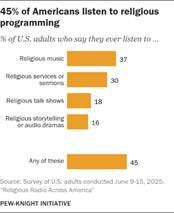
Pew found that roughly half of U.S. adults (45%) say they listen to at least one kind of religious programming. That listening breaks down across several familiar categories:
Religious music (37% of adults ever listen)
Sermons and religious services (30%)
Religious talk shows (18%)
Religious storytelling or audio dramas (16%)
Listening Patterns by Religious Affiliation
One of the clearest patterns in the report is that religious affiliation strongly shapes who listens. White evangelical Protestants (76%) and Black Protestants (84%) are the most likely to say they tune in to religious programming.
Catholics and White nonevangelical Protestants listen at lower rates, with about four in ten in each group saying they do. A similar share of adults who identify with a religion other than Christianity (39%) also listen, though they are more likely to find that content online than on AM or FM radio. That makes sense, especially if the available stations do not reflect their tradition and listeners have to go looking for programming that feels more at home.
Religious “nones,” those who identify as atheist, agnostic, or “nothing in particular,” are the least likely to listen. Even so, 18% say they still engage with some form of religious programming.
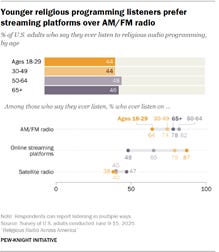
Age, interestingly, matters less than one might expect. Pew found that nearly identical shares of adults ages 18 to 49 (44%) and adults 50 and older (47%) listen to religious programming. The difference is less about whether they listen than about what they choose: older audiences are somewhat more likely to listen to sermons and services, while younger listeners are more likely to move across other forms of religious audio.
Where People Listen
People are also listening in more ways than we might assume. About three-quarters say they still use AM or FM radio at least occasionally for religious programming, while a nearly identical share (70%) turn to streaming or podcast platforms. Satellite radio trails behind, but it still reaches a substantial share of listeners (41%).
There is, however, a generational difference in how people get there. Among listeners 50 and older, 82% say they use AM or FM radio at least occasionally. Among listeners ages 18 to 29, 87% say they listen through online streaming platforms. The older habit of radio listening has not disappeared, but it now shares the field with a much more digital listening culture.
Wherever people listen, they mostly do so in the ordinary spaces of daily life: at home (93%), in the car (87%), in public spaces (55%), and even at work (51%). Religious audio is not just something people seek out in explicitly sacred moments. It travels with them through errands, commutes, routines, and the texture of an ordinary day.
Why People Listen
For many listeners, this kind of programming carries real spiritual weight. About 37% say it is extremely or very important to their religious or spiritual lives, and another 35% say it is somewhat important. For a large share of its audience, religious audio is not just background noise. It is part of how faith is sustained and lived.
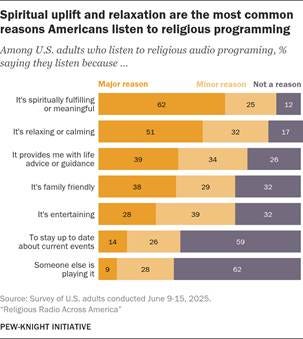
What draws people in, though, is less information than atmosphere. Listeners most often describe religious programming in affective and practical terms. They turn to it for uplift, calm, guidance, and a sense of steadiness.
· It is spiritually uplifting (62%).
· It is relaxing or calming (51%).
· It provides life advice or guidance (39%).
· It is family friendly (38%).
Current events barely register by comparison. While 40% of listeners say staying up to date is at least a minor reason they tune in, only 14% call it a major one. For most people, religious programming is not primarily about information. It is about encouragement, calm, guidance, and familiarity.
Its influence also extends beyond the moment of listening. About half of listeners say they have watched a movie or read a book they heard promoted there, and roughly a third say they have started a new religious practice because of something they heard. One-quarter say they either bought a product mentioned on these programs or changed their financial habits in response. This is not only media people consume. It is media that can redirect behavior.
Why Listening Context Matters
Before getting to where people listen, it helps to say more clearly what they are hearing.
That helps explain the familiar complaint that so much contemporary worship music seems to be trying to sound like Coldplay. The comparison is a little glib, but it points to something real. A great deal of contemporary worship music shares the same sonic grammar: swelling piano lines, delayed electric guitars, atmospheric pads, a slow build from intimacy to anthem, and choruses built to feel emotionally expansive in roughly the same way. Not every song sounds identical, and Coldplay is hardly the only influence worth naming. Still, a narrow pop-rock palette has become so dominant that it can begin to sound like sincerity itself.
Busman draws on media scholar Fabian Holt to sharpen the point: “the process of genrefication is based on the transformation of dynamic social relationships into a stable body of sonic signifiers.” Once a particular sound comes to be recognized as praise and worship music, that sound begins to define the genre itself. It shapes what listeners expect, what artists create, and what producers are willing to promote. Musicians may try to keep the sound fresh, but they usually do so within narrow stylistic boundaries, careful not to move so far outside the genre that the music no longer registers as worship. It becomes a feedback loop, guided partly by consumer preference and partly by the effort to stretch that preference without losing it.
Busman also notes that in the 1970s you had to ask whether a song was meant for worship. The style itself did not tell you. Now the genre often announces itself before the lyrics ever arrive. You can hear that it is praise and worship music almost immediately. In the 1970s, much of it sounded like rock music first, and only later revealed what it was doing.
I know this leaves aside the many other genres shaped by Christian themes and the artists who would still call themselves Christian even if their music never appears on Christian radio. But for the purposes of this essay, Christian radio largely means worship music. That is the sound most listeners are actually hearing.
Interpassive Worship
At this point, Busman introduces the concept of interpassivity, and it helps name something important about how mediated worship works. Interpassivity is not simple passivity. It is a form of delegated participation: the sense that someone else is doing the act on our behalf while we still receive some of the emotional or symbolic satisfaction of having taken part ourselves. We are not fully absent, but neither are we fully engaged. We experience a mediated version of participation that can feel real enough to satisfy, at least for a time.
A simple way to understand this is through media we already know well. Think about watching a livestream, a Twitch stream, or a YouTube video of someone playing a game. You are not the one playing, and yet you can still feel caught up in the action. The experience carries some pleasure, tension, and immediate participation even though you remain a spectator. Something similar happens in parasocial relationships. A viewer can begin to feel they know the person on screen, that they are in some kind of mutual familiarity, even though the relationship is entirely one-sided. The medium produces a powerful sense of closeness without the vulnerability, reciprocity, or actual encounter that genuine relationship requires.
That dynamic matters for worship music because so much contemporary praise and worship is built around what Busman calls a portable affect: a sonic environment that can be carried from the sanctuary into the car, the kitchen, the gym, or the commute while still feeling spiritually charged. As he puts it, “At the core of worship’s definition as genre and function as a portable affect is a sonic ideal rooted in ‘liveness,’ which is also necessarily bound up in interpassive connection.” The live worship recording is especially powerful here. Crowd noise, swelling dynamics, spontaneous exhortations, and the audible response of a congregation all help create the sense that the listener is not merely hearing worship but joining it. Even highly polished studio versions often preserve traces of that atmosphere. The music is designed to feel inhabited, communal, and already in motion, so that the listener can step emotionally into a worship event taking place somewhere else.
Praise and worship on the radio can simulate the feeling of worshiping together without requiring the practices that constitute worshiping together: showing up, singing with other bodies in the room, responding to one another, submitting to the awkwardness and contingency of a local congregation, and offering one’s voice rather than simply receiving someone else’s. The listener may feel joined not only to the artist but to an imagined community of other listeners hearing the same song at the same moment. That feeling is not nothing. It can be emotionally powerful, even comforting. But it is still mediated, asymmetrical, and largely nonreciprocal.
The problem is not simply that people enjoy worship music outside church. It is that mediated worship can satisfy enough of the desire for connection, transcendence, and shared feeling that the ordinary demands of congregational worship begin to feel thin by comparison. A local service may seem musically flatter, less immersive, less emotionally immediate, less seamless than the curated experience of radio or streaming. Once that happens, the benchmark for what worship should feel like has quietly shifted from the gathered church to the mediated soundscape. What begins to erode is not only musical expectation but ecclesial imagination. Worship starts to look less like a practice of mutual presence and more like an atmosphere one enters.
Addicted to Worship
Another problem with the dominance of praise and worship on radio and streaming platforms is the way it can train people into what might fairly be called worship addiction. Ethnomusicologist and worship scholar Monique Ingalls notes that some listeners describe themselves as “worship junkies,” always chasing the next “worship fix.” That language reveals something important. Major worship brands are not simply responding to preexisting spiritual needs. They also produce desire. The industry does not merely serve a hunger for worship. It intensifies and organizes that hunger in particular ways.
That difference helps name the gap between a Christian life and what we might call a worship lifestyle. A Christian life is ordered, however imperfectly, toward following Christ in the whole of one’s existence: prayer, repentance, work, love of neighbor, material generosity, ordinary faithfulness, and participation in the local church. A worship lifestyle can become organized around the consumption of worship culture itself. It means filling daily life with worship playlists, pursuing the emotional height of concerts and livestreams, buying the branded merchandise, and learning to associate spiritual vitality with staying inside the atmosphere the worship industry creates. None of those practices is wrong on its own. But together they can shift the center of gravity. Worship stops being one practice within Christian discipleship and starts to function as a lifestyle identity, even a market identity, of its own.
Once that shift happens, emotional intensity can begin to feel like the measure of spiritual depth. If worship is experienced mainly as repeated immersion in songs, brands, aesthetics, and curated moments, then discipleship can start to look like maintaining access to that feeling. People keep listening, attending, buying, and returning not only because the music is meaningful, but because it has become the most recognizable way of sensing closeness to God. Consumerism is part of the problem, but not the deepest part. The deeper issue is theological. Worship becomes detached from the harder, slower, less marketable practices of Christian formation.
This also loops back to interpassivity. A person may feel that they are worshiping because they are continuously surrounded by worship media, when in fact they may mostly be consuming an experience engineered to feel worshipful. They sing along, feel moved, and receive some of the affective satisfactions of devotion without necessarily being drawn more deeply into the costly, ordinary work of becoming Christlike. That distinction matters. The question is not whether worship music is good. The question is whether the worship ecosystem trains people toward love of God and neighbor, or whether it keeps training devotion toward worship culture itself.
Singing Heaven Down
One common way of understanding congregational worship is to see it as the creation of a sacred space that mediates between the gathered church and the ideal community of heaven. As Monique Ingalls writes, worship gives “participants a way to perform the eschaton, inviting them to extend the song of heaven to earth, and, in the process, to imagine their gathered…community in relationship to the ideal heavenly community.” She goes on to describe “the joyful sounds of the faithful” as “sonic agents” that prepare the way for God’s kingdom to come on earth. In this sense, worship is not only a preview of heaven but a provisional participation in it. The worship space becomes, as she puts it, a “sonic interchange between heaven and earth.” Worship is therefore an eschatological practice: it teaches believers what heavenly praise is imagined to be, trains them to inhabit it, and invites them to experience it, however partially, in the present.
That heavenly imagination matters for radio and mediated worship because these media can make eschatological participation feel widely accessible, portable, almost continuous. A listener in the car or at home can be drawn into the sonic atmosphere of heavenly praise without entering a church building or joining a gathered congregation. That is part of the appeal. The music carries transcendence into ordinary life. But it also raises a theological question. If worship is increasingly encountered as a curated atmosphere delivered through speakers and headphones, believers may begin to associate participation in the life of heaven less with the concrete practices of the church and more with the affective experience of being surrounded by worshipful sound. The danger is not that mediated worship gestures toward heaven. The danger is that the gesture can begin to feel sufficient on its own.
Headphones, Speakers, and Live Sound
It is worth pausing over a distinction that matters more than we usually admit. Listening to worship music in headphones is not the same as hearing it through speakers, and neither is the same as singing and hearing it live in a room with other people. These are not just different formats for the same content. They shape how worship music is felt in the body, how it occupies space, and what kind of spiritual relation it invites: private, environmental, or communal. If repeated worship music helps form our emotional life, then the conditions under which we listen matter almost as much as the songs themselves.
When worship music is heard through headphones, it becomes especially intimate and interior. The song arrives directly at the ear, largely cut off from the acoustics of a room and from the presence of other bodies. That can make worship feel unusually immediate and emotionally concentrated. A chorus of surrender, comfort, or nearness can seem to speak almost from within the self. Details become vivid. The song feels close, almost internal. Research on embodied listening has even found that people may move more when listening through headphones than through speakers, suggesting that playback method changes how music is taken up bodily. But that intimacy is also what makes headphone listening so individualizing. Worship becomes privatized. It creates a portable interiority, a small devotional world one carries alone.
Listening to worship music through speakers is different. Speakers place the music out in the room, where it interacts with walls, furniture, distance, and anyone else who happens to be present. Even when one is listening alone, speaker-based worship feels less sealed and less interior than headphones. Music becomes part of a shared environment rather than a private channel. It can still be immersive, but it is immersive in a more public way. Worship music in this setting often functions less like an inner soundtrack and more like an atmosphere that fills a kitchen, a car, an office, or a sanctuary. That matters because it preserves more readily the sense that worship happens around us and among us, not only inside us.
Live worship differs again. In a room where people are singing, sound is not only heard but physically shared. It is shaped in real time by acoustics, breath, bodies, timing, imperfections, crowd response, and the unpredictability of presence. A live worship song is never just an audio signal. It is an event. One does not simply receive it but inhabits it with others. That is why live worship can feel thicker than either headphones or speakers, even when it is musically rougher. Its power often lies not in sonic polish but in co-presence, in the fact that praise is happening here, now, with these people, and that one’s own voice and body are implicated in it. Listening live means being drawn into an act that is communal before it is merely expressive.
Seen this way, the difference is not only technological but theological. Worship music in headphones tends toward inwardness and personal intensity. Worship music through speakers tends toward shared atmosphere and environmental presence. Worship music heard live tends toward mutual participation and embodied response. None of these contexts is inherently bad. Each can serve real goods. They do not, however, form the worshiper in the same way. Headphones may deepen private affective attachment. Speakers may sustain a sense of worshipful atmosphere in daily life. Live music more directly trains responsiveness, reciprocity, and participation with other bodies. For a tradition that claims worship is something the church does together, those differences are not incidental. They shape whether worship is experienced mainly as an inner feeling, a surrounding environment, or a communal act.
Christian Radio Individualizes Worship
Those differences matter because Christian radio gathers all of them into a single, repeated stream. It moves easily between speakers, headphones, dashboards, kitchens, and earbuds, and in each setting it is received a little differently. Because it travels so easily across those settings, it also personalizes worship in ways that are easy to miss. What sounds shared at the level of broadcast is often lived at the level of private experience.
Christian radio can feel like a shared stream, but it is received in deeply personal ways. It reaches people while they are moving through the day, driving to work, washing dishes, walking alone, and in each setting the broadcast folds into whatever life already feels like in that moment. A worship song through the dashboard at sunrise lands differently than the same song heard late at night through headphones. The music does not arrive in a vacuum. It meets people inside their existing emotional world. That is part of what gives it formative power. Christian radio settles into the textures of daily life and begins shaping feeling from within them.
That personal quality is intensified by the simple fact of choice. People do not listen to every station. They gravitate toward voices, songs, and styles that already feel spiritually familiar, whether that means hymns, contemporary worship, call-in talk, or testimony-driven programming. Even then, the experience is rarely neat or complete. It comes in fragments: a song during the school run, a prayer between errands, a half-heard reflection while dinner is cooking. Over time, those fragments begin to gather. They form something like a private liturgy, not ordered by the church calendar or a formal service, but by repetition, habit, and return. What emerges is not a coherent service so much as a devotional collage, one quietly assembled within the listener’s own patterns of attention.
The spoken voice matters here too. Radio has a way of collapsing distance. A host or DJ can sound less like a broadcaster and more like someone sitting beside you. Testimonies, prayer segments, and gentle commentary often carry the cadence of personal care rather than formal instruction. And because there is no image to fix the voice in place, listeners supply the rest with imagination. They picture the speaker, hear warmth in the pauses, and fill tone with presence. That imagined closeness can be comforting, especially for people carrying loneliness, grief, or spiritual exhaustion. Over time, the voice becomes part of the listener’s emotional world: a companion, a guide, sometimes even a stand-in for community.
Radio also works on memory. Songs return across days, weeks, and seasons, attaching themselves to ordinary and extraordinary moments alike: a diagnosis, a long season of waiting, a hard conversation, an unexpected joy. Because radio keeps flowing, it resists tidy boundaries. It spills into a person’s biography. Over time, what it leaves behind is not just information or even belief, but a repertoire of feeling, ways of hoping, trusting, enduring, or expecting God to meet them. That repertoire is never neutral. Radio can strengthen courage, patience, and consolation. It can also normalize triumph while leaving little room for unresolved grief. Its power lies in that constancy. What returns often enough begins to sound not just familiar, but true.
That may be the deepest point. Christian radio does not only fill silence or accompany devotion. It helps school the emotions. It teaches people, by repetition, what comfort sounds like, what hope sounds like, what faithfulness is supposed to feel like. Sometimes it widens the heart. Sometimes it narrows it. But either way, the songs that keep returning do more than stay with us. They begin to shape us.
So perhaps the most practical response is also the simplest: pay attention to what keeps returning. Notice which songs have become part of your inner speech, which emotions they make easier to feel, and which ones they leave harder to name. Ask whether your soundtrack is widening your life with God or narrowing it. And if it is narrowing it, start listening more deliberately. Make room for songs that teach you how to grieve, wait, confess, hope, and sing with other people, not only songs that know how to soothe you on your own.